
Enterprises are feeling increasing pressure to integrate Artificial Intelligence (AI) into their operations. This urgency is pushing leadership teams to adjust their investment strategies to keep up. Recent advancements in Generative AI (GenAI) are further increasing this pressure, as these technologies promise to enhance productivity and efficiency across the organization.
For example, Gartner™ expects GenAI to play a role in 70% of text- and data-heavy tasks by 2025, (up from less than 10% in 2023), and 60% of marketing departments to be using some form of GenAI (such as image, video, audio, AI avatars or advertising platform solutions) by 2025, (up from less than 10% in 2023).
One of the main challenges for technology and leadership teams when making investment decisions is finding use cases and development strategies that will incrementally and gradually produce significant results over time.
To do that effectively, it’s important to establish clarity and a common understanding across all stakeholders regarding the key concepts, essential components and best practices involved in developing AI solutions.
Key concepts in developing AI solutions
The terms AI, machine learning, and GenAI usually come up in discussions involving AI – and are often even used interchangeably.
To be clear, even though these are closely related concepts, they are not necessarily the same, and may only be used interchangeably depending on the context.
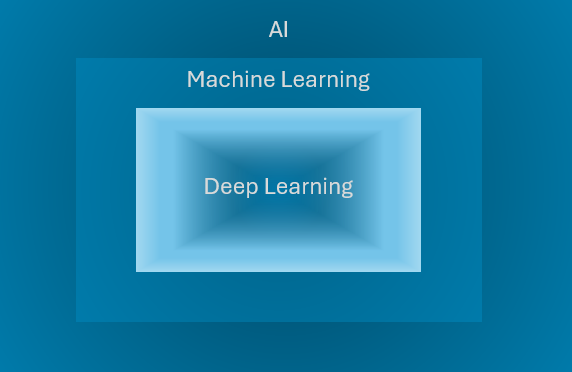
AI is an umbrella concept that encompasses a broad range of technologies and techniques aimed at creating machines or software that can perform tasks requiring human intelligence. This includes learning, reasoning, problem-solving, perception, language understanding, and more.
Its primary goal is to automate tasks, enhance decision-making, and mimic cognitive functions to solve specific problems across various domains, such as healthcare, finance, automotive, and more. Examples of applications include robotics and autonomous systems.
Machine learning (ML) is a subset of AI that focuses on the development of algorithms that allow computers to learn from and make decisions based on large datasets and statistical methods.
It is applied in predictive analytics, recommendation systems, image and speech recognition, and more. An example application is an image recognition system that can classify objects in photos. Through its ability to learn from data, it contributes to achieving AI goals such as predictive maintenance systems in manufacturing.
GenAI is also a subset of AI focused on generating and creating new content in the form of text, images, audio, video, and other data formats. Its main goal is to generate data that mimics or exceeds human-like creativity, including generating realistic images, composing music, writing articles, and more.
It mainly relies on advanced neural network architectures with deep learning at its core. Deep learning, a type of machine learning, requires substantial computational resources and high-quality, diverse datasets for training effective generative models.
These models are excellent at detecting complex patterns in data, making them ideal for tasks such as creating original music in various styles, generating new clothing designs, writing software code, and more. ChatGPT™ is an example of a GenAI solution that uses a transformer-based deep learning algorithm.
Essential components of AI solution development
Developing an AI solution involves several essential components that span from problem definition to deployment and maintenance.
The following are some key essentials that should be considered.
- Use cases: Clearly define the problem you aim to solve, including business outcomes, performance metrics, data needs, and development, test, and deployment environments.
- Data collection and preparation: Identify and gather relevant data from various sources, then integrate, transform, clean, label (if necessary), and enhance the dataset through augmentation, synthetic data generation, etc.
- Infrastructure and tools: Ensure access to sufficient computational power for training models, adequate storage for large datasets, reliable networking for data transfer and distributed computing, AI frameworks and libraries like TensorFlow and Scikit-learn, and self-service platforms with platform engineering, data engineering, and analytics capabilities.
- Algorithms and model selection: Select appropriate algorithms and models based on the problem, data characteristics, and performance requirements; choose model design, such as neural network, decision tree, etc.; and utilize and fine-tune pre-trained models, if available.
- Model training: Categorize the dataset into training, validation, and test datasets; implement a robust training pipeline (like MLflow, Kubeflow, or Flyte) to ensure regular monitoring and validation; and optimize hyperparameters to enhance model performance.
- Evaluation and testing: Define and monitor key metrics such as accuracy, precision, recall, F1 score, etc.; validate the model on a separate dataset to ensure it generalizes well to new data; and conduct thorough testing, including adversarial examples to identify potential weaknesses.
- Deployment: Choose the appropriate deployment environment (cloud, on-premises, edge devices), ensure scalability with increased demand, and maintain performance.
- Monitoring and maintenance: Continuously monitor the model’s performance in production and track relevant metrics; regularly update the model with new data and retrain as necessary to maintain accuracy; and implement mechanisms for detecting, logging, and handling errors.

Teams involved in AI solution development
AI development projects typically involve a diverse set of enterprise teams and personas, each bringing their expertise to ensure the successful planning, development, deployment, and maintenance of AI solutions.
The following are the key roles involved:
- Executive leadership: This includes the C-level leadership team tasked with the mandate to provide strategic direction and ensure alignment of AI projects with the organization’s goals; fund and oversee the technological and infrastructure aspects of the AI initiatives; and manage the organization’s data strategy, governance, and data-related policies.
- Project management: This involves product owners and project managers responsible for defining the product vision and roadmap, as well as coordinating the project and managing timelines, resources, and stakeholders to ensure successful delivery.
- Business and domain expert: This includes domain experts and business analysts who provide subject matter expertise to ensure the AI solution is relevant and effective for the specific industry or application area and translate business requirements into technical specifications.
- Data and AI specialists: This involves data engineers, data scientists, ML engineers, and AI research scientists responsible for designing and maintaining the data pipelines and architectures; developing ML models, conducting experiments, and interpreting data to provide actionable insights; implementing and optimizing machine learning models; and conducting research to develop new AI methodologies and improve existing algorithms required for AI solutions.
- Software engineering and DevOps: This includes architecture, engineering, DevOps and user experience teams tasked with designing, developing and integrating AI models into applications; maintaining continuous integration and continuous delivery (CI/CD) pipelines; developing and executing tests to ensure the solution meets functional, performance and reliability standards; and managing the deployment, scaling, and monitoring of AI models to ensure seamless functionality and user experience.
- Infrastructure and platform teams: This includes cloud, platform, and network engineering and operations teams responsible for cloud and on-premise infrastructure management, including computational resource and environment allocation and provisioning; platform solution implementations to configure, automate and enable self-service capabilities to development teams to accelerate their project delivery; and secure network infrastructure design, implement, manage, and support.
- Ethics and compliance: This involves ethics and compliance officers responsible for ensuring that the AI solution adheres to ethical guidelines and best practices, addressing issues like bias and fairness as well as ensuring it complies with relevant laws, regulations, and industry standards, particularly regarding data privacy and security.
Best practices for developing AI solutions
Developing AI solutions requires a structured approach to ensure the resulting systems are efficient, reliable, and ethically sound.
Here are some best practices for developing AI solutions:
- Be pragmatic: When embarking on your AI journey, it is best to start small. Experiment, learn, and gradually expand the complexity and scope of selected use cases. Be practical in choosing your first use cases. Ensure you have the necessary data and skills to support them. Define your expected outcomes clearly, using specific metrics.
- Care about ethics and compliance: When building AI solutions, it’s crucial to address bias, fairness, security, privacy, and transparency. Ensure your models are fair and unbiased by actively working to eliminate any detected biases. Follow data privacy laws, protect sensitive information, and maintain transparency in how your models make decisions. Always provide explanations when needed.
- Adopt a self-service platform: Consider using a self-service platform, like Calibo, which integrates multiple tech stacks. Such platforms provide cloud, technology, and data orchestration, helping to harmonize diverse technologies, teams, and disciplines in AI solution development. This approach simplifies and speeds up delivery.
- Fine-tune and optimize over time: If necessary, models should be fine-tuned with domain-specific data. Apply techniques like pruning and knowledge distillation to make the model more efficient continually.
- User feedback and iteration: Continually collect feedback from users and iteratively enhance the models based on user feedback, new data, and changing requirements.
- APIs and services: Develop APIs or integrate the model into existing services for easy access and utilization.
How Calibo enables the AI solution development journey
The Calibo platform is an end-to-end enterprise solution that simplifies, democratizes, and speeds up the digital creation process.
It enables collaboration between multiple teams and personas, including product managers, platform teams, data engineers, software developers and citizen developers allowing them to move from ideation to market in half the time at a lower cost.
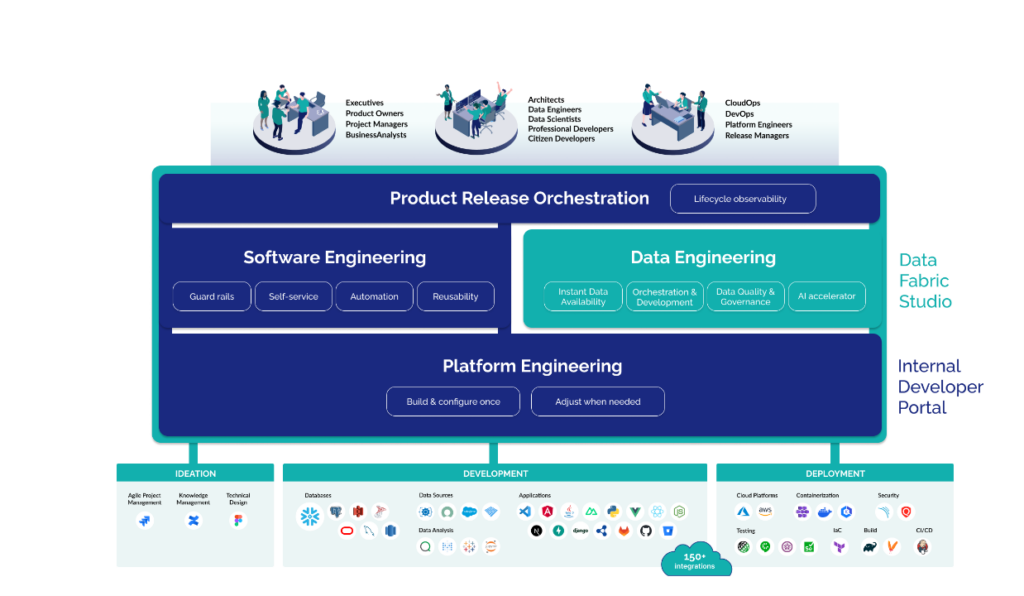
The Calibo platform integrates with 150+ best-of-breed technology stacks and enriches it with template-enabled automation, orchestration and product release capabilities to accelerate product delivery.
It provides Internal Developer Portal (IDP) and Data Fabric capabilities that enable the following digital product delivery practices:
- Platform engineering – allows platform teams to configure cloud platforms and technologies to enable orchestration, automate repeatable tasks, and configure guardrails that enable self-service environment provisioning and tooling capabilities for development teams to accelerate their work.
- Data engineering – offers a data fabric design studio that helps data and AI professionals, as well as citizen developers, build data pipelines and analytics solutions. This involves ingesting data from various sources, integrating, transforming, and enriching it to create a single, reliable source of truth in data lake house platforms like Snowflake.
- Software engineering – enables self-service environment provisioning and tooling with template-driven tech-stack specific source code management and CI/CD pipeline automation as well as containerized deployment orchestration.
The Calibo platform enables capabilities that power AI solution development and addresses several of the AI development essentials outlined earlier.
- Use cases – product owners use the Calibo platform, integrated with Jira and Confluence, to define digital portfolios containing products and features for selected AI use cases. They collaborate with business analysts and domain experts to outline business requirements, epics, and user stories in Jira, linking them to the product features.

- Data collection and preparation – data engineers use the Calibo Data Fabric Studio to design data pipelines for AI use cases. They ingest and integrate data from multiple sources, then transform, clean, and enrich it to create a single source of truth in a data lake house like Snowflake. They can speed up their work by using pre-defined data source configurations, data pipeline templates, and data ingestion catalogs set up by platform engineers or other data professionals within the organisation.
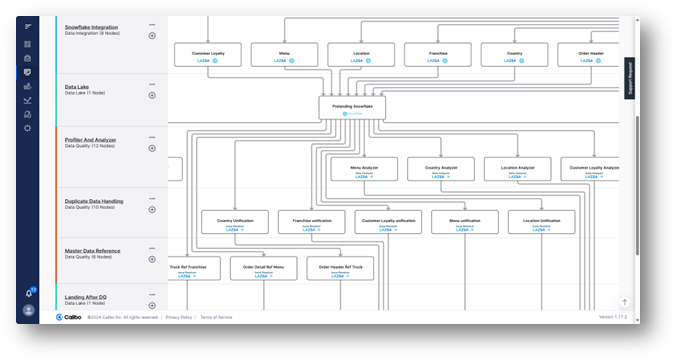
The platform helps them by offering pre-integrated tech stacks like Python with JupyterLab. It also provides self-service capabilities for developing, testing, and deploying their solutions, alongside source code management, CI/CD pipeline automation, and deployment orchestration. Embedded ready-to-use ML algorithms may be used to further speed up their work.

- Infrastructure and tools – Platform teams speed up AI use case development in Calibo by setting up configurations for developer self-service enablement. They integrate over 150 cloud platforms and tech stacks, including AWS, Azure, Snowflake, Python with JupyterLab, GitLab, and ML Flow. They also automate routine tasks like CI/CD pipelines and set standardization policies to guide development teams.
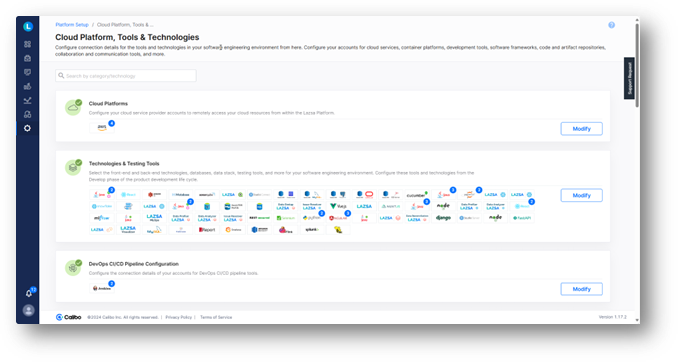
- Algorithms and model selection – the Calibo platform integrates with key technologies like Python with JupyterLab. It includes source code and CI/CD pipeline templates as well as containerized deployment orchestration. This setup helps AI developers create and deploy their ML algorithms and models efficiently. The platform comes with several ready-to-use ML algorithms such as Linear Regression, Logistics Regression, and Random Forest Classifiers, that developers may use as a starting point to expedite their work.
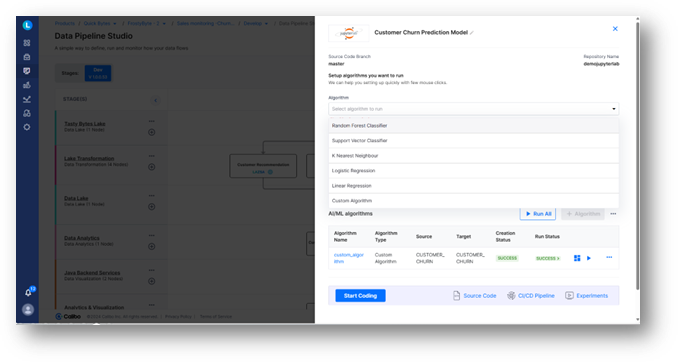
- Model training – the Calibo platform facilitates this operation through its Data Fabric Studio to support dataset categorization and through its integration with MLOps tools like MLFlow.
- Evaluation and testing – the Calibo platform facilitates this operation through its integration with MLOps tools like MLFlow.
- Deployment – the Calibo platform provides containerized and non-containerized deployment infrastructure provisioning and orchestration capabilities that can be used for AI solution component and model deployments and environment promotions – from dev to test, to staging, and to production. It includes integrated support for Docker, Kubernetes, OpenShift and Terraform.
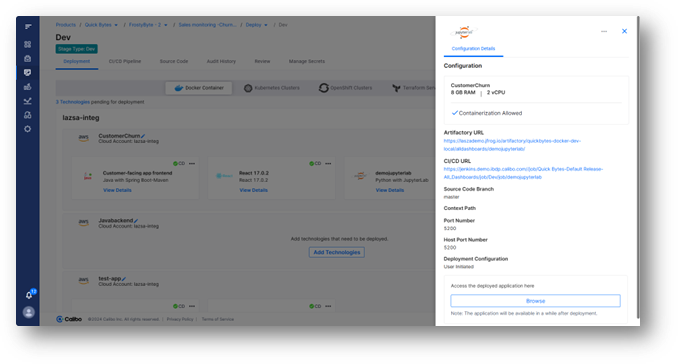
- Monitoring and maintenance – the Calibo platform provides capabilities for monitoring the data and CI/CD pipelines that are used for the AI solution development. This provides the relevant insights and alerting capabilities that improves the effectiveness of solution maintenance and support.

The Calibo platform supports all stages of AI solution development by offering a unified workspace. This single-pane-of-glass allows all stakeholders to collaborate and access project information, tools, technologies, requirements, designs, development, and deployment artefacts, as well as actionable monitoring insights.
The platform also enables users to document and access feedback within specific AI projects, allowing for continuous improvements to the models.
Additionally, it integrates back-end and front-end technologies with necessary orchestrations and automation. This helps other development teams accelerate the creation of solutions that complement AI projects and enhance business capabilities.
Key takeaways
The pressure on enterprise leadership teams to remain competitive by adopting AI to boost productivity and efficiencies across the enterprise is growing.
Leadership and technology teams must establish clarity and a common understanding of the key concepts, essential components, and best practices involved in developing AI solutions that successfully deliver high-impact business value.
Enterprises should consider using a self-service platform for AI solution development (such as Calibo). This choice democratizes, simplifies, and speeds up solution delivery. It also helps implement key AI development essentials and industry best practices.
Learn about how Calibo can empower your teams, and streamline your digital development for quicker market delivery here.
Trending articles
How Calibo’s IDP helps you to deploy your own large language model (LLM)
As you may know, Calibo empowers developers to create UIs and APIs in just minutes, with seamless deployment to multiple platforms including EC2, Kubernetes, and OpenShift. In this blog post, we’ll walk you through the steps to create a React web app and a chatbot widget, along with an API that loads Meta’s Llama2 model.…

Data mesh vs data fabric: Understanding key differences and benefits
One thing I love about working in tech is that the landscape is constantly changing. Like the weeping angels in Dr Who – every time you turn back and look – the tech landscape has moved slightly. Unlike the weeping angels, however – this progress is for the betterment of all. (And slightly less murderous).…

Unlocking the true potential of CI/CD pipelines for improved productivity
Measuring developer productivity has always been a challenge in the software industry. Traditional metrics like committed code or merged pull requests provide some insight but often fail to capture the true impact of developers’ work. Consider this scenario: a developer merges just one pull request in a week, consisting of only one line of code,…

5 common pains without a platform engineering solution
Embracing platform engineering is becoming increasingly critical in today’s digital landscape, where efficiency and automation are key drivers of success. However, many organizations still rely on traditional or manual approaches to software development, deployment, and operations, leading to a host of challenges that can impede progress and innovation. Without a platform engineering solution, teams often…